January 30, 2025 (last updated Febuary 16, 2025)
TikTok transformed from a teen-centered app into a global town square in just a few short years, but the threat of a ban has always loomed behind its success. ByteDance acquired the short-form video app Musical.ly in November 2017 for around $1 billion and merged it with the newly created TikTok on August 2, 2018. In this article, we’ll trace the timeline of the TikTok ban, highlighting key moments that have shaped the app’s current situation.
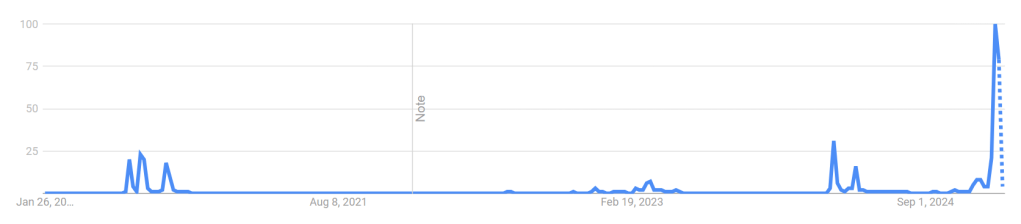
Source: Google Trends. This graph represents the interest of the term ‘TikTok ban” from January 2020 through January 2025.
October 9, 2019 Marco Rubio raises concern about TikTok.
Florida Senator Rubio writes a letter to Secretary of Treasury Steven Mnuchin requesting an inquiry into ByteDance’s purchase of Musically. Data security finished the call to action but the focalpoint was the app’s censorship to the Chinese government’s standards.
October 24, 2019 Two Senators bring attention to TikTok’s potential risks.
Republican Senator of Arkansas Tom Cotton and Democratic Senator of New York Chuck Schumer sent a letter advocating for an assessment of TikTok’s potential national security risks to the Director of National Intelligence.
December, 2019 TikTok banned from U.S. Navy and Army devices.
Guidance was released by the U.S Navy and Army to delete TikTok from Government equipment and to consider removing the app from personal devices. The guidance was expanded to all military devices a few weeks later in January.
May 15, 2020 No TikTok on Government Devices Act introduced in the House.
The farthest reaching ban thus far was introduced by a Colorado House representative Ken Buck. It prohibited TikTik from all U.S. federal employees and officer’s devices besides exemptions to be outlined in the future.
June 29, 2020 TikTok banned in India.
India had 200 million TikTok users when it was banned abruptly. For context, the U.S. had around 50 million active users in 2020 and around 120 million in 2024. TikTok and several other Chinese-owned apps were banned after weekslong military tensions at its border. On June 15th, fighting between troops from India and China broke out, resulting in fatal violence in India’s Galwan Valley where both sides assigned blame to each other. Troops have occupied both borders since 1962 but skirmishes haven’t been fatal since 1975.

Photo credit: Google Maps
July 7, 2020 Mike Pompeo said U.S. is considering banning TikTok.
While serving as Secretary of State, Mike Pompeo said banning TikTok is possible in an interview with Laura Ingraham on Fox News. While nothing concrete was discussed, this moment was quoted and reposted, reopening the TikTok ban conversation.
July 8, 2020 Trump mentions banning TikTok in interview.
When asked in an interview with Greta Van Susteren about Secretary Pompeo’s comment from the day prior, Trump reiterated a ban on TikTok was possible providing vague evidence for the decision.
“Well, it’s a big business. Look, what happened with China with this virus, what they’ve done to this country and to the entire world is disgraceful. And we are looking at numerous different things. TikTok’s one of them, one of many.” said President Trump.
August 6, 2020 Trump signs an executive order to ban TikTok in 45 days.
A lot of information came from this day. President Trump signed an executive order starting a 45-day countdown for sanctions on all businesses owned by ByteDance, forcing the company to divest from China or risk being banned from doing business in the U.S., including with Apple and Google app stores.
Senate accepts No TikTok on Government Devices Act.
The Senate heard arguments from Missouri Representative Josh Hawley and Florida Representative Rick Scott about the dangers of TikTik’s data collection, bringing forward the No TikTok on Government Devices Act to be voted on. It was passed with unanimous consent.
August 14, 2020 Trump signs executive order to force ByteDance to divest from China.
This order extended the previous bill to 90 days, giving TikTok more time to divest or sell. It also had stipulations about destroying U.S. data from TikTok and Musically, the app that was absorbed into TikTok in 2017.
August 24, 2020 ByteDance sues Trump administration.
ByteDance filed a complaint in federal court against the Trump administration’s executive order, insisting on their commitment to protecting U.S. user data. ByteDance also accused the Trump administration of acting in bad faith by providing no evidence for the ban.
June 9, 2021 President Joe Biden rescinds Trump’s executive order to ban TikTok.
In a sweeping executive order reversing three of Trump’s orders, President Biden reversed TikTok’s fate. No ban of any Chinese-owned apps had yet taken place due to ongoing litigation.
July 21, 2021 TikTok’s lawsuit dismissed.
President Biden, who inherited ByteDance’s lawsuit in his role as President, and TikTok agreed to dismiss the case without prejudice, meaning either party could refile in the future.
June 17, 2022 Bytedance moves U.S. data to U.S. servers.
TikTok announced working with Oracle Cloud Infastructure’s U.S. servers to store U.S. user’s data in the country.
TikTok’s U.S. Security Public Policy employee Albert Calamug said “Today, 100% of US user traffic is being routed to Oracle Cloud Infrastructure. We still use our U.S. and Singapore data centers for backup, but as we continue our work we expect to delete U.S. users’ private data from our own data centers and fully pivot to Oracle cloud servers located in the U.S.”
December 14, 2022 Senate reintroduced and passed No TikTok on Government Devices Act.
The Senate again passed a bill that forces TikTok’s removal from any tehnology owned by federal agencies and to develop standards to allow exceptions.
February 27 2023 White House issued 30-day deadline to remove Tiktok from government devices.
The Trump Administration posted a memo setting a 30-day deadline to ensure TikTok is removed from all government-owned devices. While this action did not affect most of the U.S. user base, it raised the possibility of a full ban in public speculation.
March 23, 2023 Tiktok CEO Shou Chew testifies before House.
Many viral moments arose from this nearly six-hour testimony of TikTok CEO Shou Chew before the House Energy and Commerce Committee.
Firstly, Chew himself is Singporean and repeatedly denied having any personal or business relationships with anyone in the Chinese communist party. When California representative Anna Eshoo asked about protecting U.S. data from China, Chew said “I have seen no evidence that the Chinese government has access to that data. They have never asked us.”
North Carolina representative Richard Hudson asked a painful line of questions about TikTok’s access to data through home wifi, which is not possible or a pressing issue. This and other similar lines of questioning led to public discourse about Congress being out of touch with relevant issues about sensitive data.
March 13, 2024 House of Representatives passes TikTok sale or ban act.
The Protecting Americans from Foreign Adversary Controlled Applications Act instructed TikTok to divest from its parent company ByteDance or face a ban from U.S. users. It named the U.S. Court of Appeals for Washington D.C. as the only entity to challenge the law. The bill passed 352-65-1.
April 20, 2024 TikTok sale or ban attached to larger spending bill.
The Protecting Americans from Foreign Adversary Controlled Applications Act was attached to a larger spending bill for national security and foreign aid toward Israel, Ukraine, and the Indo-Pacific region. A deadline extension was also amended for ByteDance to sell its stake in TikTok in 270 days. The package passed in the House 360-58.
April 23, 2024 The Senate passed spending package.
The Senate agreed 79-18 to the House-made amendments of the bill and sent the law identified as H.R.815 to the White House.
April 24, 2024 President Joe Biden signed the TikTok sale or ban bill into law.
The TikTok sale or ban countdown to January 19, 2025 began with public law No. 118-50. It allowed for a one-time 90-day extension invoked by a President who then must present a plan for U.S. user’s data security.
May 7, 2024 TikTok filed a lawsuit in U.S. Court of Appeals.
The suit focuses on the unconstitutionality of the Protecting Americans from Foreign Adversary Controlled Applications Act that banned TikTok, the singling out of TikTok for data concerns, and the legality of unprecedentedly forcing the sale of a social media company.
December 6, 2024 Judge continued with TikTok sale or ban.
Washington D.C’s Court of Appeals decided to allow TikTok’s sale or ban to take place on January 19, 2025.
Chief Judge Sri Srinivasan wrote “I fully join all aspects of the court’s opinion today other than Part II.B, which rejects TikTok’s First Amendment challenge. As to that challenge, I agree with my colleagues that the Act does not violate the First Amendment.”
December 27, 2024 Trump files a request to block the ban or sale of TikTok.
This brief asked the Court of Appeals to stay, or temporarily halt the proceedings until the Trump Administration can pursue negotiations in office on January 20, one day after the proposed sale or ban deadline. Trump filed the brief as Amicus Curiae or friend of the court, someone not affiliated with either party but has expertise in the case.
January 17, 2025 Supreme Court upheld the TikTok sale or ban as constitutional.
The Supreme Court issued a per curiam, or unanimous decision agreeing the Protecting Americans from Foreign Adversary Controlled Applications Act is legal and upheld TikTok’s sale or ban on January 19.
January 18, 2025 TikTok goes dark for U.S. users.
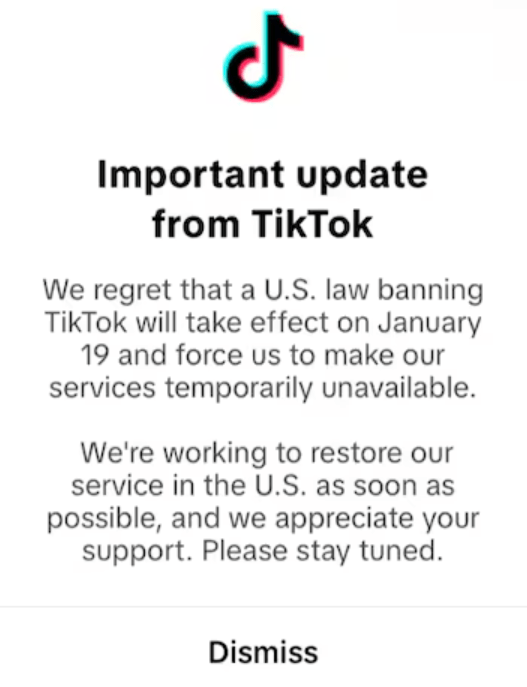
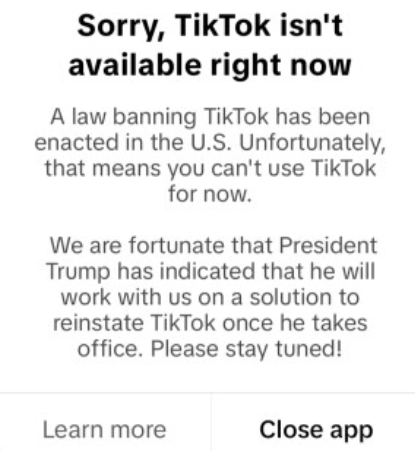
Around 10p.m., TikTok displayed a message upon opening the app that it was no longer available due to U.S. law and was removed from all app stores.
January 19, 2025 Trump promises to issue an executive order against TikTok sale or ban.
President-elect Trump posted a promise on Truth Social to temporarily reverse the TikTok ban, writing “I will issue an executive order on Monday to extend the period of time before the law’s prohibitions take effect, so that we can make a deal to protect our national security…”
Trump also recognized TikTok in a pre-inauguration rally for its impact on youth voting and proposed a 50/50 split ownership of TikTok with a U.S. bidder, an idea also mentioned in his earlier Truth Social post.
TikTok became live for U.S. users.
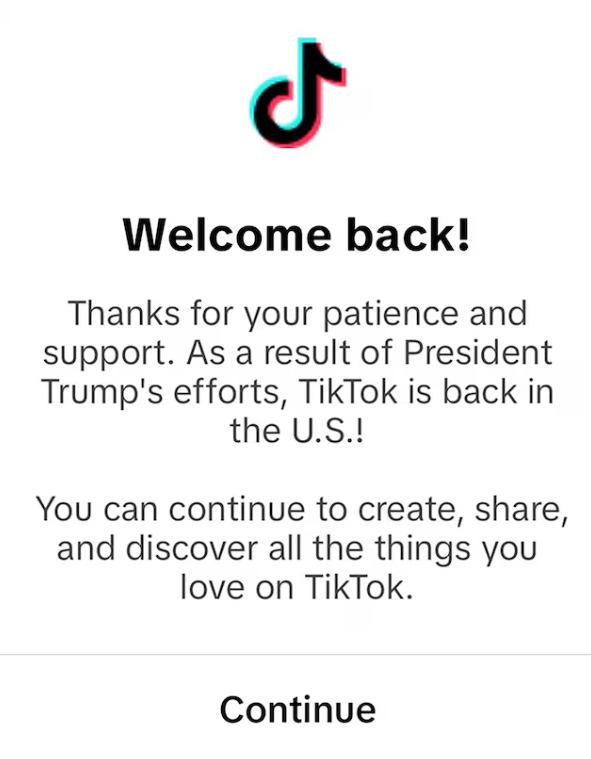
A few hours after Trump’s announcement to extend the sale or ban date, TikTok was available at limited capacity for U.S. users whose app remained downloaded on their phones. It is still unavailable to download on any platform.
January 20, 2025 Trump passed executive order prolonging TikTok’s sale or ban.
For 75 more days, TikTok can accessed by U.S. users. President Trump said he wanted “to allow my Administration an opportunity to determine the appropriate course forward in an orderly way that protects national security while avoiding an abrupt shutdown of a communications platform used by millions of Americans.”
January 27, 2025 Apple adds a notice to support page about TikTok.
Apple wrote TikTok can’t be downloaded on new devices in the U.S. It will remain on devices that have it downloaded but in-app purchases like TikTok Shop and upgrades will not be available.
Febuary 13, 2025 TikTok returns to app stores
Apple and Google restored TikTok to their app stores after a letter from US Attorney General Pam Bondi promised not to pursue fines, as first reported by Bloomberg.
 KaseyDeschler.com